Exclusive Fine Art Photography Blog | Aaron Feinberg: The Ultimate Guide to Photographing the Na Pali Coast | A Local Photographer's Perspective
Aloha all!
After almost 19 years of living on Kaua'i and photographing the Na Pali Coast from just about every angle imaginable – helicopters, boats, jet skis, cliff edges, and more miles of muddy trail than I care to remember...I've learned a few things about capturing this place.
The Na Pali Coast is, without question, one of the most photographed landscapes on Earth. And for good reason. Those fluted emerald cliffs, the way light moves through the valleys, the sheer scale of it...there's nothing else like it. But here's the thing: most of the photography advice out there comes from people who visited for a week.
This guide comes from someone who's been chasing light on these cliffs since 2007. Let me share what actually works.
Understanding the Na Pali Coast
First, some context. The Na Pali Coast stretches approximately 17 miles along Kaua'i's northwest shore. "Na Pali" means "the cliffs" in Hawaiian, quite appropriate after all. These cathedral-like spires rise up to 4,000 feet, carved over millions of years by wind, rain, and the relentless Pacific.
There's no road. No easy access. You're either on the water looking up, in the air looking down, or on foot working your way along the Kalalau Trail. Each perspective offers something completely different, and honestly, you need all three to truly understand this place photographically.
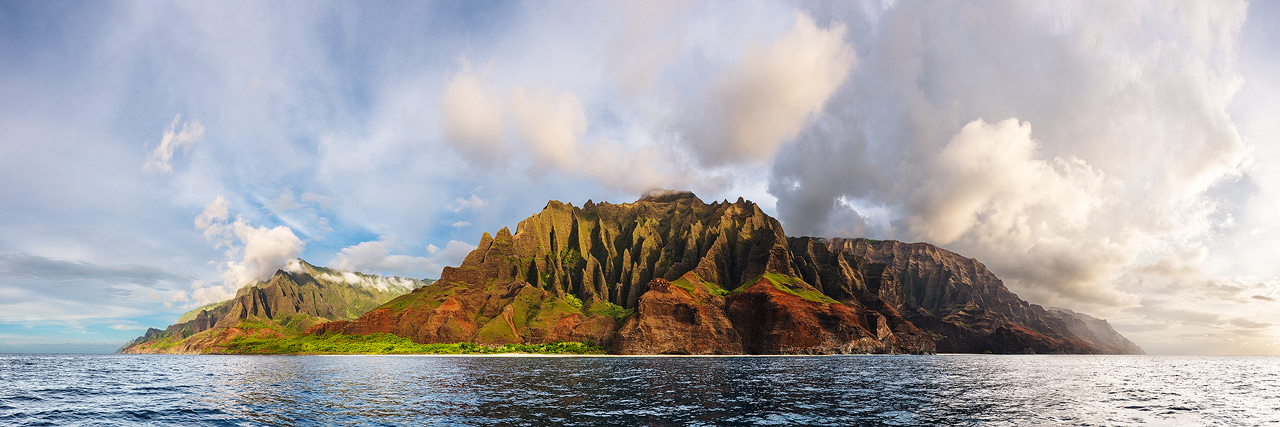
The incredible Na Pali Coast as seen from just off shore. To read the story of how this was captured from the back of a jet ski be sure to read the blog post!
Limited Edition of 300. - Tier 4
Artist Proof of 30.
*Sizes 10'+ are possible with this image.
Photographing Na Pali by Boat
This is how most visitors experience the coast, and with good reason, it's accessible and the views are spectacular.
Best time of day: All times of day! It's amazing how different light changes the textures and views of the coast. Midday can be the most tricky, but under the right conditions you'll get unique shadows and light play especially if the light is dappled. Early morning you can get stunning colors in the water (as seen in Emerald City I & II and beams of light streaming over the cliffs. At sunset you get the warm light accentuating the relief of the topography.
Best time of year: Summer (May through September) offers the calmest seas and best boat access. Winter swells can reach 30+ feet, making tours inconsistent or impossible – though when conditions align, the ehu kai (sea spray) hugging those cliffs at sunset is absolutely magical. I've chased that shot more times than I can count.
Pro tips:
- Book a tour that allows you to move around the vessel. Being stuck in one seat limits your angles dramatically.
- Bring a longer lens (70-200mm or equivalent) in addition to your wide angle. The cliffs are massive, but isolating details...a single waterfall, the texture of a ridge, often makes a stronger image than trying to capture everything.
- Clean your gear after. Salt spray is real, even on calm days. I've seen photographers learn this the hard way. Damp cloth wipe down after you get back goes a long way. If you leave spray on the lens, be careful when cleaning later as it needs to be damp again to not have the salt scratch the filters or lens.
- Sea caves are incredible but dark. Know your camera's limits and don't be afraid to push your ISO to keep your shutter speed high enough to keep things sharp.
My image above, "Lost World," was actually captured from the back of a jet ski during an 8-frame panoramic stitch. Not recommending that approach for everyone...but sometimes you do what you have to do.

The Na Pali coast is a place like no other. This particular photo was taken as the morning light streamed over the imposing cliffs creating this incredible emerald green water in front of Kalalau and the Cathedrals. The light reflecting off the rocks add to the dappled colors in the ocean with the towering 4,000 ft mountain behind. A horizontal companion piece to "Emerald City". Epic morning!
Limited Edition of 150.
Artist Proof of 15.
Photographing Na Pali by Helicopter
Aerial photography of the Na Pali Coast is a completely different experience. You're not looking UP at the cliffs – you're eye-level with them, or above, peering down into valleys that are otherwise invisible.
Doors off vs. doors on: Doors off, always. Yes, it's louder and windier. Yes, your heart rate will spike. But the difference in image quality is night and day – no reflections, no glass distortion, unlimited angles.
Best time of day: Late afternoon provides the most dramatic light, but morning flights often have clearer conditions (less haze, fewer clouds building up). I've had stunning results at both times – it really depends on the day.
Best time of year: Winter brings more waterfalls cascading down the cliffs after heavy rains. Summer offers clearer skies and calmer conditions. Both have their magic.
Pro tips:
- Shoot at 1/1000 sec or faster to compensate for helicopter vibration
- Use a wide to mid-range zoom (24-70mm is ideal) – longer lenses are tough to stabilize
- Communicate with your pilot about what you're trying to capture. The good ones understand photography and can position accordingly.
- Strap everything down. Anything not secured WILL attempt to leave the helicopter. You will need a camera strap on your camera around your body.
The scale from the air is humbling. Kalalau Valley – "the valley of life" – opens up below you in ways that are impossible to comprehend from any other vantage point.
Photographing Na Pali on Foot: The Kalalau Trail
This is where things get real.
The Kalalau Trail runs 11 miles from Ke'e Beach to Kalalau Valley, gaining and losing thousands of feet along the way. It's considered one of the most dangerous trails in the world – and one of the most beautiful. A permit is required to enter Ke'e Beach Park so plan ahead. Check Go Ha'ena for more information!
For photography, the most accessible opportunities:
Ke'e Beach (see permit above): The trailhead area itself offers incredible views back toward the first cliffs of Na Pali (be sure to walk down the beach to the right), especially at sunset. I've spent countless evenings here, waiting for waves to crash just right against the rocks, for that perfect moment when the light goes golden and the mist rises. My image "Kaboom!" came from sitting on those rocks for two hours...waiting...waiting...waiting. Set after set would roll through with nothing. Then suddenly...impact and explosion. Three frames. That was it. One wave in 2 hours. Completely worth it.
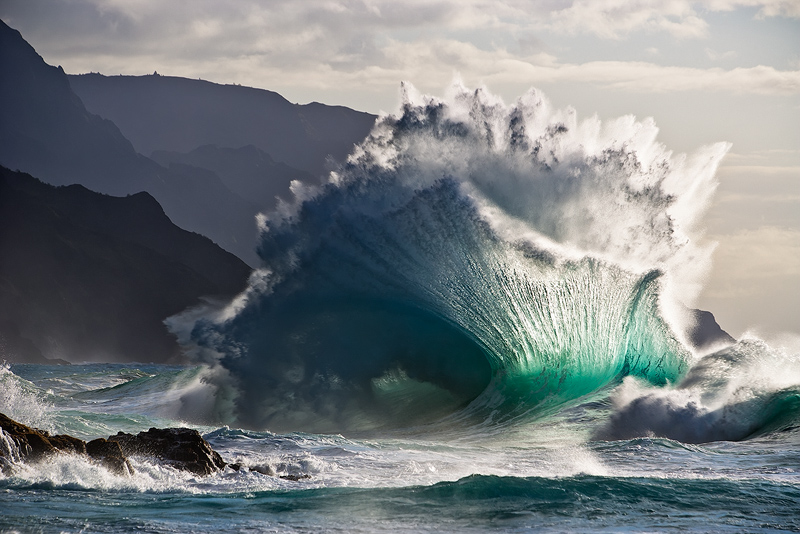
Waves collide in spectacular fashion along Kaua'i's Na Pali coast. Winner of; Nature Photo Of The Year - American Photo Magazine '09, Photo Of The Month - National Geographic - Aug '10, many others...
Limited Edition of 300 (per size).
Artist Proof of 30.
The first half-mile of trail: Even a short hike up gains you elevation and perspective that most people miss. During winter swells, the ehu kai builds along the cliffs in ways that are impossible to capture from sea level. One evening with 30+ foot surf, I made that climb specifically chasing heavy sea spray at sunset. The colors were unreal – one of my all-time favorite shoots.
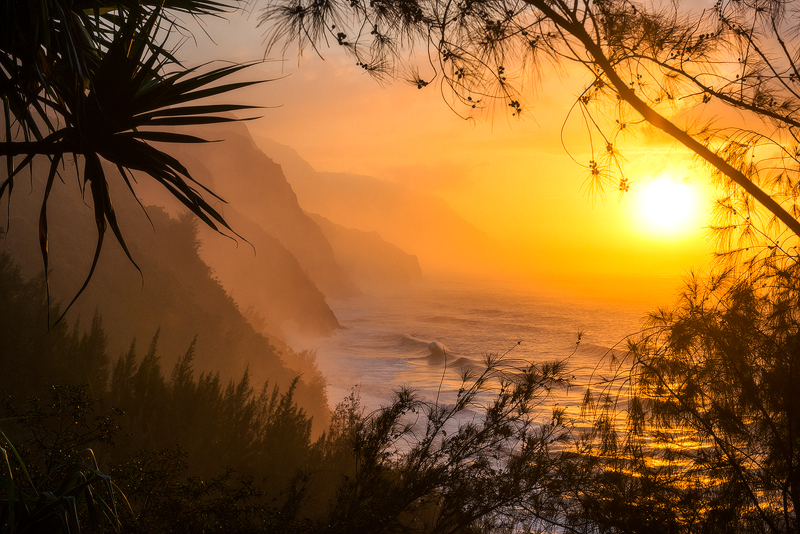
Conditions that one chases for a long time and then it finally aligns. Large surf, light winds and one hell of a sunset. Majestic paradise along the Na Pali Coast on Kaua'i.
TIER 7
Limited Edition of 30.
Artist Proof of 3.
Kalalau Lookout (via Koke'e, no hiking required): Here's the secret most visitors miss...you can see INTO Kalalau Valley from above without hiking the trail at all. Drive up to Koke'e State Park on the west side, continue to the Kalalau Lookout at 4,000 feet, and you're looking straight down into the valley. A lot of people visit the canyon but fail to make it to the top...dont miss it! Sunset from here can be extraordinary...if the clouds cooperate. I've arrived to completely socked-in conditions, sat and waited, and watched holes open up in the valley just as the light went golden. Patience is everything. "Kalalau Solstice" came from one of those evenings – just me and a friend, the clouds parting at exactly the right moment, a solitary rain cloud passing in the distance. Doesn't get any better.
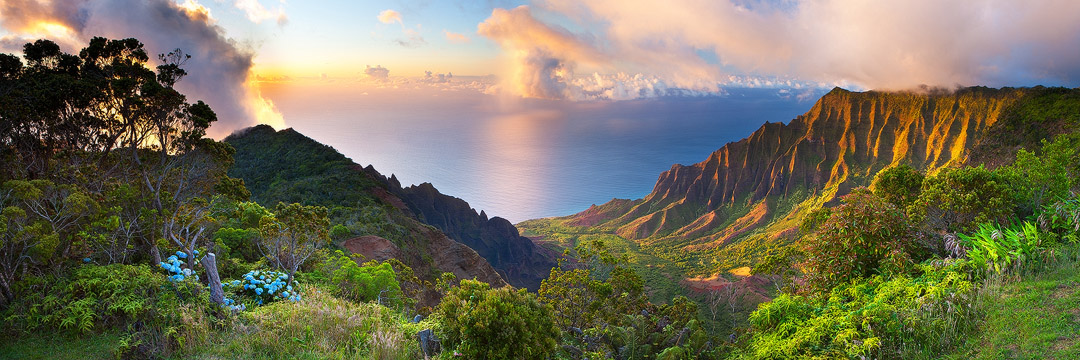
One of the most surreal view points I have ever seen combined with some of the best light I could have imagined. The best part, we had the overlook to ourselves. Paradise!
Limited Edition of 300 (per size).
Artist Proof of 30.
Seasonal Considerations for Na Pali Photography
| Season | Conditions | Best For |
|---|---|---|
| Winter (Nov-Feb) | Large swells, more rain, dramatic waterfalls, rougher seas | Waterfall photography, dramatic seascapes from shore, ehu kai (sea spray) |
| Spring (Mar-May) | Transitional, lush greenery, improving seas | Boat tours resuming, vibrant colors, fewer crowds |
| Summer (Jun-Aug) | Calmest seas, clearest skies, driest conditions | Boat access to sea caves, snorkeling stops, aerial photography |
| Fall (Sep-Oct) | Transitional, still relatively calm, shoulder season | Fewer tourists, good conditions, softer light |
There's no bad time, honestly. Just different opportunities. Some of my favorite images have come from "bad" conditions that created something unexpected.
Gear Recommendations
I shoot with a Nikon Z7II these days, but the principles apply regardless of system:
- Wide angle (14-24mm or similar): Essential for capturing the scale, especially from boats and helicopters. Remember low and wide, get close to your subject!
- Mid-range zoom (24-70mm): Your workhorse for most situations
- Telephoto (70-200mm): Invaluable for isolating details, especially from boats
- Polarizing filter: Cuts glare on water, deepens skies, essential for this environment
- ND filters: For longer exposures of waterfalls or smoothing ocean texture
- Rain protection: Kaua'i's north shore is one of the wettest places on Earth. Prepare accordingly.
- Sturdy tripod: For any land-based shooting where shutter speed matters
Final Thoughts
I've been photographing the Na Pali Coast for nearly two decades now, and it still surprises me. The light is never the same twice. The weather shifts constantly. What looks impossible at 4pm becomes transcendent at 5:30pm.
The best advice I can give? Slow down. Be patient. Return multiple times if you can. The Na Pali doesn't reveal itself to people in a hurry.
And if you capture something that moves you – even if it's "just" a phone photo...that's the point. The goal isn't technical perfection. It's connection. It's standing in front of something so impossibly beautiful that you have to try to hold onto it somehow.
That's why I'm still out there chasing light after all these years.
If you're visiting Kaua'i and want to see what 18+ years of Na Pali obsession looks like in print, swing by either of my galleries – Grand Hyatt Resort in Poipu or Ching Young Village in Hanalei. Happy to talk story about any of this.
aF